
Faqs
FAQs
Frequently Asked Questions
Everything you need to know about buying, hiring, and modifying shipping containers with Containex Pro.
We stock a wide range of container sizes to suit every requirement. Our most popular sizes are 10ft, 20ft, and 40ft standard containers, as well as 40ft High Cube containers which offer an extra foot of internal height — ideal for conversions. We also carry 45ft containers for specialist applications. If you're unsure which size is right for your project, our team is happy to advise — just give us a call or use the live chat.
New (factory-new) containers have never been used for cargo and are in pristine condition — perfect for high-end conversions. One-trip containers have made a single voyage from the manufacturer, so they are nearly new in appearance with minimal wear. Used containers (also called WWT — Wind and Watertight) have completed multiple cargo journeys and may show cosmetic dents, surface rust, or paint loss, but are fully structurally sound and weatherproof. Used containers are the most cost-effective choice for general storage.
Yes. All containers sold by Containex Pro are guaranteed to be Wind and Watertight (WWT) at the point of delivery. Our new and one-trip units come with a 12-month structural warranty. If you receive a container that does not meet the condition described at the time of purchase, we will rectify or replace it at no cost to you. We stand fully behind the quality of every unit we supply.
Absolutely. You are welcome to visit our depots to inspect containers before purchase. We encourage this for customers ordering multiple units or high-specification one-trip containers for conversion projects. Please contact us in advance to arrange a convenient time. Alternatively, we can provide a detailed photo and video report of any specific unit before it is reserved for you — at no extra charge.
Yes — we offer competitive volume pricing for customers purchasing 3 or more containers. The larger the order, the greater the saving per unit. We work regularly with self-storage operators, developers, logistics companies, and construction contractors who order in bulk. Please contact our sales team directly for a bespoke quote; we'll always work hard to give you the best possible price for your order volume.
Yes, we offer flexible short-term and long-term container hire. Hire is ideal if you need storage for a specific project, event, or seasonal period without the commitment of a purchase. Hire agreements start from as little as one month and can be extended on a rolling monthly basis. Ask our team for current hire rates — buying often works out more cost-effective if you need the container for more than 12 months.
Our minimum hire period is 28 days (one calendar month). After the initial period, hire continues on a rolling monthly basis and can be terminated with 28 days' written notice. There are no long lock-in contracts unless you specifically request a fixed-term agreement (which may attract a discounted rate). This flexibility makes us a popular choice for construction sites, events, and seasonal businesses.
Yes — this is a very popular option. If you are currently hiring a container and decide you would like to purchase it outright, we offer a hire-to-buy scheme where a portion of the hire payments you have already made can be deducted from the final purchase price, subject to the age and condition of the unit. Speak to our team at any time during your hire period to discuss converting to a purchase.
The container remains the property of Containex Pro throughout the hire period. The hirer is responsible for keeping the unit secure, not overloading it, and not making structural alterations without written consent. Any damage beyond fair wear and tear during the hire period may be charged at the end of the agreement. We recommend hirers ensure the unit is covered under their own site or property insurance during the period of hire.
Containers are delivered on a tilt-bed (skeletal) or HIAB crane lorry depending on the access and positioning requirements at your site. Tilt-bed delivery is the most common method — the lorry tilts and slides the container off the back. A HIAB crane is used where the container needs to be placed over an obstacle, in a confined space, or in a position the lorry cannot directly access. Our team will discuss which method is appropriate when you place your order.
As a general guide, a tilt-bed delivery lorry for a 20ft container requires approximately 18–20 metres of straight run-up in front of the drop position. For a 40ft container, allow approximately 25–30 metres. The lorry also needs enough overhead clearance and width to manoeuvre. If you have restricted access, please let us know in advance — we can assess your site and arrange a HIAB crane delivery where needed. We won't attempt a delivery that risks damage to your property or the unit.
Containers are designed to sit on their four corner castings, so the ground surface needs to be reasonably level and firm enough to support the weight (a fully loaded 20ft container weighs up to approximately 24 tonnes). Suitable surfaces include concrete, tarmac, compacted hardcore, or level ground with railway sleepers under each corner. We advise against placing containers on soft or uneven ground without proper support, as this can cause the doors to rack and become difficult to open.
We aim to deliver within 3–7 working days of payment being received for most locations. In many cases — particularly for in-stock standard units — we can arrange delivery within 24–48 hours for urgent requirements. Delivery timescales for modified containers depend on the scope of modifications required. We'll always give you a confirmed delivery date at the time of order and keep you updated throughout.
Yes — we deliver nationwide from our network of strategically located depots, ensuring competitive delivery costs and efficient lead times wherever you are. Delivery charges vary depending on your location and the size of the container. We provide a full all-inclusive delivered price when you request a quote, so there are no surprises. Contact us with your postcode and container requirements for an instant delivery price.
We strongly recommend that someone is present at the delivery address to direct the driver to the exact placement position and to sign the delivery confirmation. If you cannot be present, you must provide clear written instructions for the driver in advance and ensure site access has been arranged. Please note that once the container has been offloaded and the driver has left, the placement cannot be adjusted without arranging and paying for an additional HIAB or crane visit.
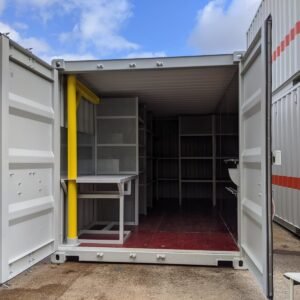
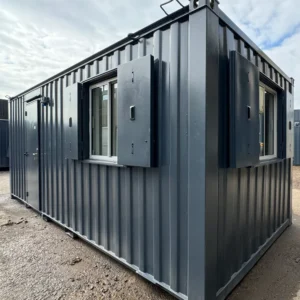
Our in-house modification team can carry out a comprehensive range of works, including: personnel doors (single and double), roller shutter doors, windows (fixed, opening, and security-barred), ventilation louvres, partition walls, electrical fit-outs (sockets, lighting, consumer unit), insulation (spray foam, PIR board), internal linings (ply, steel, anti-condensation), shelving and racking, steel staircases, roof lights / skylights, external cladding (timber, composite), branding and wrap, and custom paint finishes. If you have a specific requirement not listed here, please ask — we'll do our best to accommodate it.
Lead times for modifications depend on the scope of work. Simple modifications such as adding a personnel door or ventilation louvres typically take 3–5 working days. Medium-complexity builds such as full electrical fit-outs or insulation and lining packages take 7–14 working days. Complex bespoke conversions (container homes, bars, offices, or studios) are planned on a project basis and timescales are agreed at the quotation stage. We will always give you a firm completion date before work commences.
All modifications carried out by Containex Pro are designed and executed to maintain the structural integrity of the unit. Where openings are cut into the container walls (for doors, windows, or roller shutters), we fit steel box-section reinforcing frames around all apertures to compensate for the steel removed. Our modification team are experienced container fabricators — not general metalworkers — and understand the structural demands of container modification. We never cut corners when it comes to structural soundness.
Yes — we are happy to carry out modifications on containers you already own, even if they were not purchased from us. Simply arrange for the container to be transported to our nearest depot and we'll carry out a condition survey before providing a modification quotation. Alternatively, for simpler modifications, we may be able to send a fabrication team to your site. Please note that we would need to inspect the container before committing to any works, as the condition of existing containers varies significantly.
Planning permission requirements depend on how and where the container is to be used. In many cases, containers used for temporary storage on private land fall within permitted development rights and do not require planning permission. However, containers used as permanent structures, dwellings, commercial premises, or placed in certain protected areas (conservation areas, AONBs, etc.) may require consent. We always recommend checking with your local planning authority before installation. We can provide supporting documentation if needed for your application.
Absolutely. We have an extensive portfolio of completed projects covering container offices, garden studios, pop-up retail units, street food kitchens, container homes, glamping pods, sports club facilities, and industrial workspaces. You can browse our project gallery on this website or ask our team to share specific case studies relevant to your intended use. We're very proud of our modification work and love to show it off — just ask.
A High Cube (HC) container is one foot taller than a standard container — 9ft 6in external height versus 8ft 6in. This gives approximately 2.7m of internal headroom versus 2.35m in a standard unit. High Cubes are the preferred choice for conversion projects (offices, homes, studios, retail) because the extra headroom makes the space feel significantly more comfortable and allows for insulation and suspended ceilings to be added without compromising usable height. For pure external storage, a standard container is usually sufficient.
A reefer (refrigerated) container is a thermally insulated unit fitted with a refrigeration unit, used for transporting and storing temperature-sensitive goods. Yes — decommissioned reefer containers are extremely popular for non-refrigeration uses because they come pre-insulated from the factory to a very high standard, with smooth GRP-lined internal walls. They make excellent hygienic storage units, laboratories, and food preparation areas. They are priced similarly to standard used containers and are excellent value for insulated applications.
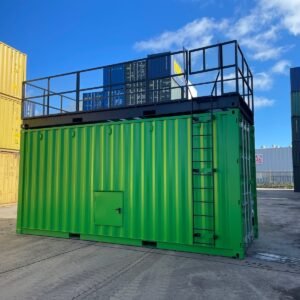
An open-top container has a removable tarpaulin roof instead of a fixed steel roof, allowing cargo to be loaded from above by crane or overhead lifting equipment. They are primarily used for oversized cargo that cannot fit through the standard end doors. Open-top containers are also popular for skip-type waste storage or as the base structure for container conversions where a full or partial rooftop terrace or green roof is planned. Ask our team if an open-top suits your specific project requirements.
Flat-rack containers have a flat steel base with collapsible or fixed end posts but no sides or roof. They are designed for transporting and storing heavy, oversized, or oddly shaped cargo such as machinery, vehicles, pipes, or structural steel. Flat racks are loaded from the sides or top and are ideal where standard box containers cannot accommodate the dimensions of the cargo. We stock both 20ft and 40ft flat racks — contact us for current availability and pricing.
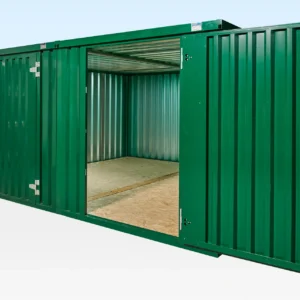
A side-opening (tunnel) container has doors fitted on the full length of one or both sides, in addition to or instead of standard end doors. This allows access along the entire length of the container, making it far easier to load and unload without needing to reach deep inside. Side-opening containers are popular for retail pop-ups, market stalls, tool stores, and vehicle parts storage where frequent and easy access to all stored items is a priority. Available in 20ft and 40ft lengths.
We accept a wide range of payment methods including BACS bank transfer (preferred for larger orders), debit and credit card (Visa, Mastercard, Amex), online checkout via our website, and cheque for established account customers. For hire agreements, we set up a monthly direct debit for simplicity. All prices on our website are exclusive of VAT unless otherwise stated — VAT at the standard rate will be added at checkout.
Yes — we offer business finance options through our lending partners for eligible customers, allowing you to spread the cost of container purchase or modification over 12 to 60 months. Finance is available for both individuals and businesses, subject to credit approval. Monthly hire is also an alternative way to manage cashflow without a large upfront purchase commitment. Contact our team to discuss the finance options available for your specific order.
For standard stock purchases, full payment is required before delivery is scheduled. For modified or bespoke containers, we typically require a 50% deposit to commence fabrication work, with the remaining balance due prior to delivery. For large volume orders, staged payment terms may be agreed at the point of sale. Deposit payments are non-refundable once modification work has commenced, so please ensure you are fully committed before placing a bespoke order.
Yes — we operate a trade account programme for contractors, developers, self-storage operators, logistics companies, and other regular buyers. Trade account customers benefit from 30-day payment terms, priority delivery scheduling, dedicated account management, and preferential pricing. Accounts are available to businesses with a demonstrable trading history. To apply for a trade account, contact our accounts team with your company details and anticipated order volumes.
Container prices displayed on our website are typically ex-depot (collection price). Delivery is quoted separately based on your location, container size, and access requirements. When you request a quote, we will always provide a fully inclusive delivered price incorporating the container, delivery, and any modifications — so you know exactly what you're paying with no hidden extras. Collection from our depots is welcome if you have your own suitable transport.
A well-maintained shipping container has an impressive lifespan. Containers used for marine cargo are typically retired from active shipping duty after 10–15 years, but once on land and properly maintained, a container can remain structurally sound and fully functional for 25–50 years or more. The key to longevity is keeping the unit off soft or waterlogged ground, treating any surface rust promptly, and repainting periodically. Many containers in land-based use continue to perform excellently well beyond 30 years.
Condensation (sometimes called "container rain") occurs when warm, moist air inside the container comes into contact with the cooler steel walls and roof. The most effective solutions are: ventilation (ensure the container's factory vents are unobstructed, or add additional louvres), silica gel desiccant packs or container desiccant bags which absorb moisture from the air, anti-condensation roof lining (a spray or blanket coating applied to the inside of the roof), and full insulation and lining for permanent installations. Our team can advise on the most appropriate solution for your specific use case.
Standard ISO shipping containers are built to carry extremely heavy loads. A standard 20ft container has a maximum gross weight of approximately 24,000 kg and a payload of around 21,700 kg. A 40ft container has a maximum gross weight of approximately 30,480 kg with a payload of around 26,500 kg. The floor of a standard container is rated to support a forklift truck with a 5,460 kg axle load. For land-based storage, these capacities are more than sufficient for almost any application.
Yes — ISO shipping containers are specifically engineered to be stacked. The corner castings at each corner of the container are the structural load-bearing points, and a standard container is rated to support a stack of up to 9 fully loaded containers at sea. On land, containers are commonly stacked 2 or 3 high. For stacking, it is essential that the containers are properly aligned on their corner castings and, for permanent stacking, that twist-locks or connector pins are used to prevent shifting. Speak to our team for advice on safe stacking configurations.
Most standard ISO shipping containers are fitted with a hardwood timber floor (typically bamboo or tropical hardwood) bolted to steel cross-members. Historically, some container floors were treated with pesticides (such as Methyl Bromide) to comply with international phytosanitary regulations. While this practice is largely discontinued in modern containers, we recommend that containers with older floors used for human habitation are surveyed and the floor replaced or overlaid as a precaution. Our team can advise on the origin of specific units and arrange floor replacement where required.
Yes — we can paint any container to virtually any RAL or BS colour to match your brand, site, or planning requirement. All paint work is carried out using high-quality industrial-grade container paint which provides excellent weather resistance and a professional finish. We can also apply vinyl wraps and full-colour branded graphics for pop-up retail, events, or marketing purposes. Custom paint and wrapping is priced per job based on container size — ask for a quote when placing your order.
Shipping containers are inherently very secure — the steel construction is extremely difficult to break through. The primary vulnerability is the standard door lock rods and padlock staples. We strongly recommend upgrading to a heavy-duty lock box (monoblock), which encases the padlock entirely in steel to prevent bolt-cutter or angle-grinder attacks. Additional security measures include container alarms, CCTV, additional hasp and staple locks, and ground anchoring. For high-value contents, we can fit security upgrades at the point of modification — ask us for details.
Insurance for the container itself and its contents is the responsibility of the owner. We strongly recommend ensuring your container and its contents are covered under your home contents, business, or site insurance policy. Many standard policies will cover containers on your own property — but always check with your insurer and declare the container to avoid any issues at claim time. For containers used commercially or on construction sites, a specialist plant and equipment policy may be more appropriate. We do not provide insurance but can recommend specialist brokers if required.
Getting a quote from us is quick and easy. You can: call our sales team directly for an instant price, use the quote form on this website and we'll respond within 2 hours during business hours, or use our live chat for a fast response. To provide an accurate quote, it helps to know your container size and condition preference (new / one-trip / used), any modification requirements, your delivery postcode, and your intended use. We're always happy to advise on the most cost-effective solution for your project.
No questions found in this category.