
Buyers Guide
Free Buyer's Guide
The Complete Guide to
The Complete Guide to
Buying a Shipping Container
Everything you need to know before you buy — from choosing the right size and condition to delivery, placement, and legal considerations. Written by our container experts with 15+ years of industry experience.
📖 15 min read
✦
Updated May 2026
✦
By Containex Pro Expert Team
Table of Contents
- Why Buy a Shipping Container?
- Understanding Container Types
- Choosing the Right Size
- New vs. Used — What's the Difference?
- Container Condition Grades Explained
- What to Inspect Before Buying
- Delivery — What You Need to Know
- Site Preparation & Placement
- Planning Permission & Legal Considerations
- Modifying Your Container
- Maintenance Tips
- Frequently Asked Questions
01
Why Buy a Shipping Container?
Shipping containers have come a long way from their origins as simple cargo vessels. Today, they represent one of the most versatile, durable, and cost-effective structures available for both commercial and residential use. Built from heavy-duty corten steel, they're designed to withstand the harshest ocean conditions — which means when used on land, they last for decades with minimal maintenance.
Whether you're a contractor looking for secure on-site storage, a business needing affordable additional space, or an individual exploring creative architecture, a shipping container offers a uniquely robust and adaptable solution. And unlike traditional building structures, containers are modular — they can be stacked, combined, relocated, and repurposed at any time.
💪
Incredibly Durable
Built from corten (weathering) steel, containers resist rust, wind, water, and impact — lasting 25+ years with basic care.
💰
Cost-Effective
Compared to traditional construction or permanent storage buildings, containers offer outstanding value at a fraction of the cost.
🔄
Fully Relocatable
Unlike permanent structures, containers can be moved whenever your needs change — simply load and transport to a new location.
⚡
Immediately Available
In-stock containers can be delivered and placed within days — no planning, no construction delays, no waiting months to use your space.
🔒
Secure by Design
Steel lockboxes, heavy-duty locking bars, and solid construction make containers one of the most secure storage solutions available.
🌱
Eco-Friendly
Repurposing used containers is a sustainable choice — recycling existing steel structures rather than consuming new construction materials.
02
Understanding Container Types
Not all shipping containers are the same. Different types are engineered for different cargo, environments, and applications. Understanding the main container types will help you choose the right unit for your specific project or storage need.
Container Type
Best For
Key Feature
Standard Dry
General storage, cargo, conversions
Most common — enclosed steel box with double doors
High Cube
Bulky goods, container homes, offices
1ft taller than standard — extra vertical space
Open Top
Tall machinery, timber, oversized cargo
Removable tarpaulin roof for top-loading
Flat Rack
Heavy machinery, vehicles, wide loads
No roof or side walls — open platform
Refrigerated (Reefer)
Food, pharma, cold-chain logistics
Built-in refrigeration unit with temperature control
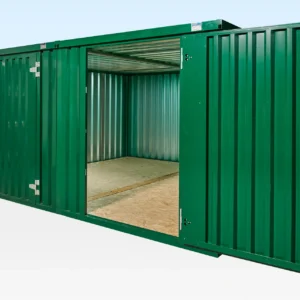
Open Side
Wide-load access, display, retail
Full-length side doors for easy lateral loading
Tank Container
Liquids, gases, chemicals
Cylindrical tank inside a steel frame
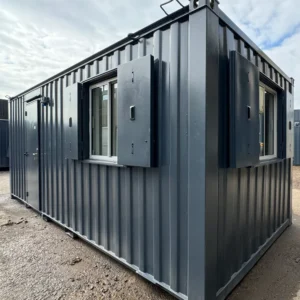
Site Cabin
Site offices, welfare units, accommodation
Anti-vandal steel, pre-fitted with windows and doors
💡 Expert Tip: For most storage and conversion projects, a standard 20ft or 40ft dry container is the best starting point. They're the most widely available, most affordable, and the easiest to modify.
03
Choosing the Right Size
Container size is one of the most critical decisions you'll make. Too small and you'll run out of space. Too large and you're paying for more than you need. Here's a breakdown of the most common sizes and their ideal use cases.
10ft
~15 CBM
- Small residential storage
- Garden storage / workshops
- Tight access locations
- Temporary secure storage
L: 2.99mW: 2.35mH: 2.39m
Most Popular
20ft
~33 CBM
- Business & commercial storage
- Construction site storage
- Container conversions
- International shipping
L: 6.06mW: 2.35mH: 2.39m
40ft
~67 CBM
- Large-scale storage
- Warehouse overflow
- Container homes & offices
- High-volume cargo
L: 12.19mW: 2.35mH: 2.39m
40ft HC
~76 CBM
- Container living / homes
- Tall item storage
- Premium office fit-outs
- Extra headroom needed
L: 12.19mW: 2.35mH: 2.70m
📏 Size Rule of Thumb: A 20ft container holds roughly the equivalent of a 2-bedroom house worth of furniture. A 40ft container holds approximately double that. When in doubt, go one size up — you can never have too much storage space.
04
New vs. Used — What's the Difference?
One of the most common questions we receive is whether to buy a new or used container. The honest answer: it depends entirely on your intended use, budget, and aesthetic requirements. Both are excellent options — here's how they compare.
✦ New / One-Trip Containers
- Made in factory, used once for delivery — essentially brand new
- Pristine condition — no dents, rust, or odours
- Clean interior — ideal for food, pharma, or sensitive goods
- Maximum lifespan — 25–30+ years with basic maintenance
- Easier to modify — clean surfaces, uniform dimensions
- Higher upfront cost than used units
- Slightly longer lead time if not in stock
Best For: Conversions, sensitive storage, long-term investment, aesthetics-critical projects
✦ Used / Cargo-Worthy Containers
- Significantly lower cost — excellent value for money
- Widely available — large stock nationwide
- Still fully wind-and-watertight when cargo-worthy graded
- Structurally sound for storage and most applications
- May have surface rust, dents, or paint wear
- Interior may have odours from previous cargo
- Shorter remaining lifespan than new units
Best For: Budget storage, construction sites, short to medium-term use, non-visible locations
05
Container Condition Grades Explained
The container industry uses a grading system to describe the condition of used units. Understanding these grades will help you set realistic expectations and choose the right container for your budget and use case.
Grade A
New / One-Trip
Used once for transport from the manufacturer. Essentially brand new with minimal to no cosmetic wear. The best quality available on the used market.
Grade B
Cargo-Worthy (CW)
Structurally sound and certified for continued shipping use. May have surface rust, minor dents, and paint wear but fully watertight. Excellent value.
Grade C
Wind & Watertight (WWT)
Not suitable for shipping but fully sealed against weather. Ideal for static land-based storage. Visible cosmetic damage but structurally intact.
Grade D
As-Is / Project Units
Significant wear, damage, or repairs needed. Sold at lowest price. Suitable for modification projects where the exterior will be fully refurbished.
💡 Containex Pro Standard: We only sell Grade A and Grade B containers as standard. All units are personally inspected before sale. Grade C units are available on request for specific storage-only applications.
06
What to Inspect Before Buying
Whether you're buying in person or ordering online, knowing what to look for in a container will ensure you receive a quality unit that meets your needs. Here is a complete inspection checklist used by our own team on every container we sell.
🔍 Exterior Checks
- No holes, cracks, or fractures in the steel panels
- Surface rust is cosmetic — check for deep/penetrating rust
- Doors open, close, and lock smoothly
- Door rubber seals are intact and not perished
- Floor is solid — no soft spots or rot (wooden floors)
- Roof is free from dents that could pool rainwater
- Corner castings are intact and undamaged
- Base rails and cross-members are straight and sound
🏠 Interior Checks
- No light visible through walls, roof, or floor seams
- No water staining or active moisture inside
- Floor is level and structurally firm underfoot
- No strong chemical or petroleum odours
- Interior walls are free from large dents or protrusions
- Locking bar mechanisms work correctly from inside
- Ventilation plugs (if present) are intact
- CSC plate is present (for Grade A/B containers)
✅ Containex Pro Guarantee: All containers sold through Containex Pro are pre-inspected against this exact checklist by a qualified member of our team. You receive a full condition report with every purchase — including real photos of your exact unit before dispatch.
07
Delivery — What You Need to Know
Container delivery requires some preparation on your end to ensure a smooth, safe, and efficient drop-off. Our delivery team will always contact you in advance, but understanding the process ahead of time will save you time and avoid any day-of issues.
1
Delivery Vehicle Requirements
A 20ft container is delivered on a standard flatbed lorry (approximately 12m long). A 40ft container requires an articulated vehicle (approximately 18m+). Ensure there is sufficient turning and access space for the delivery vehicle to reach your site safely.
2
Off-Loading Method
Containers are typically delivered via tilt-bed (the trailer tilts and the container slides off) or hiab crane (a mounted crane lifts the container into position). Tilt-bed requires roughly 1.5× the container length of clear ground ahead of the drop point. Hiab requires overhead clearance of approximately 6–7 metres.
3
Ground Conditions
The delivery vehicle must be able to access and manoeuvre on firm, level ground. Soft, muddy, or uneven ground can prevent safe delivery or damage your site. Inform our team of any access restrictions, slopes, or surface conditions before your delivery date.
4
Someone Must Be Present
An authorised person must be on-site at the time of delivery to direct placement and sign the delivery note. Our driver will confirm the exact positioning before off-loading. Once signed off, the container cannot be repositioned by our team without an additional charge.
5
Delivery Timescales
Most in-stock containers are delivered within 3–7 business days from order confirmation. Express next-day delivery is available in most areas for an additional charge. Remote or restricted-access locations may require longer lead times. Our team will confirm your delivery window at the time of booking.
08
Site Preparation & Placement
Proper site preparation is essential to the long-term performance of your container. A container placed on uneven or unsuitable ground will be harder to open, more susceptible to rust, and may develop structural issues over time. Follow these best practices for optimal placement.
⬜
Use a Solid, Level Base
The ideal foundation is a level concrete pad, compacted hardcore, or railway sleepers. The base must be flat to within 25mm across the full footprint of the container. An uneven base causes doors to rack and seals to fail.
💧
Ensure Good Drainage
Position the container so that water drains away from the base. Never place a container in a hollow or depression where rainwater can pool beneath the floor, as this accelerates corrosion of the undercarriage.
🌬️
Allow Air Circulation
Leave at least 150mm of clearance between the container sides and any walls or fences. Air circulation prevents moisture buildup, damp, and condensation — the primary causes of interior rust and container "sweat".
🚪
Plan Door Access
Allow a minimum of 1.5 metres of clear space in front of both container doors for safe, comfortable access. For forklift access, allow a minimum of 3–4 metres of clear space directly in front of the door end.
☀️
Consider Sun Orientation
If storing temperature-sensitive goods, position the container with its longest side facing away from direct afternoon sun. This can reduce internal temperature by up to 10–15°C during summer months.
🔐
Security Positioning
Position your container so the door end faces inward toward a building or secure fence where possible. Consider installing a lockbox over the padlock hasp, which is the most effective anti-theft upgrade for any container.
09
Planning Permission & Legal Considerations
In most cases, placing a shipping container on private land for storage does not require formal planning permission — but there are important exceptions. The rules vary significantly by location, intended use, and duration of placement. Always check with your local planning authority before installation.
✅ Generally Permitted
- Temporary storage on private land (under 28 days in some jurisdictions)
- Agricultural use on farmland
- Storage within existing commercial/industrial premises
- Construction site storage (temporary)
- Containers placed within enclosed yards or warehouses
⚠️ May Require Permission
- Permanent placement on residential land
- Containers visible from a public highway
- Use as a habitable space (office, home, retail)
- Listed buildings or conservation areas
- Stacking multiple containers
🚫 Usually Not Permitted
- Placement in designated green belt land
- Use as permanent residential dwelling without consent
- Blocking public rights of way or sightlines
- Placement that violates existing planning conditions
- Storage of hazardous materials without licensing
📋 Important: Planning rules vary by country, state, and local authority. This guide provides general guidance only. Always verify with your local planning department before purchasing a container for a specific use. Containex Pro's team can also advise based on your intended use and location.
10
Modifying Your Container
One of the most powerful advantages of a shipping container is its adaptability. With the right modifications, a standard steel box can be transformed into a fully functional office, retail unit, pop-up café, workshop, or even a home. Containex Pro's in-house modification team handles everything from simple aperture cuts to complete full fit-outs.
🚪
Doors & Windows
Personnel doors, roller shutters, panoramic windows, and skylights can all be cut and fitted to your specification.
⚡
Electrical Fit-Out
Full wiring, consumer units, sockets, LED lighting, and external power connection — compliant with local wiring standards.
🌡️
Insulation & Climate Control
Spray foam, PIR board, or rockwool insulation plus HVAC units for year-round temperature control.
🎨
Painting & Branding
Full exterior paint in any RAL colour plus vinyl wrap branding, logos, and graphics for retail or promotional use.
🚿
Plumbing & Welfare
Sinks, toilets, showers, and welfare facilities can be fitted to create compliant site welfare or washroom units.
📐
Flooring & Cladding
Anti-slip flooring, vinyl, carpet, or hardwood internally. Timber cladding, composite panels, or renders externally.
11
Maintenance Tips
A well-maintained shipping container can last 25 years or more with minimal intervention. The good news: containers are extremely low-maintenance by design. Follow these simple annual checks to keep your container in optimal condition for decades.
1
Inspect and treat surface rust annually
Surface rust is normal and purely cosmetic on corten steel. Treat any rust spots with a wire brush and rust-inhibiting primer paint once per year to prevent it penetrating the steel.
2
Lubricate door hinges and locking bars every 6 months
Apply a marine-grade grease or WD-40 to all hinges, locking cams, and door bars every six months to prevent seizing and ensure smooth operation year-round.
3
Check door seals annually
Inspect the rubber door seals for cracking, perishing, or compression failure. Seals are inexpensive and easy to replace — and are the primary defence against water ingress.
4
Keep the roof clear of debris
Leaves, branches, and pooled water on the roof accelerate rust. Clear the roof seasonally and ensure there are no low-hanging branches in contact with the container top.
5
Ventilate regularly to prevent condensation
"Container sweat" — internal condensation — is common in sealed containers. Open doors periodically for air circulation, or install additional vents if the container is used for storage of moisture-sensitive goods.
6
Check the undercarriage annually
Inspect the base rails and cross-members for rust buildup, especially if the container sits on soil or grass. Apply rust-inhibiting paint to the underside every 2–3 years as a preventative measure.
12
Frequently Asked Questions
How much does a shipping container cost?
Prices vary based on size, condition, and location. A used 20ft container typically starts from $1,500–$3,000. A new one-trip 20ft starts from $3,000–$5,000. 40ft containers range from $2,500–$6,500+ depending on grade. Delivery costs are additional and depend on your location. Contact Containex Pro for an instant personalised quote.
How long does delivery take?
Most in-stock containers are delivered within 3–7 business days from order confirmation. Express next-day and same-week delivery options are available in most areas. Remote or restricted-access locations may require longer lead times. Our team will confirm your exact delivery window at booking.
Do I need planning permission for a shipping container?
In most cases, no — for temporary storage on private land. However, planning requirements vary significantly by location and intended use. Containers used as offices, retail units, or dwellings typically require formal planning consent. Always check with your local planning authority. See Section 9 of this guide for full details.
What is the difference between a new and used container?
A new (one-trip) container has been used just once to transport goods from its country of manufacture — it's essentially brand new. Used (cargo-worthy) containers have had multiple shipping voyages and show normal wear and tear, but are fully structural and watertight. New containers cost more but offer a pristine finish and longer remaining lifespan. See Section 4 for a full comparison.
Can I stack shipping containers?
Yes — standard ISO containers are engineered to be stacked up to 9 units high when loaded. For land-based stacking, ensure the ground can bear the combined weight and that you have safe access to upper containers. Note: stacking typically requires planning permission in residential areas.
How do I prevent condensation inside my container?
Condensation ("container sweat") occurs when warm, moist air contacts the cooler steel walls. Prevent it by: installing ventilation vents (top and bottom), using desiccant moisture absorbers inside, lining the walls with insulation, and opening the doors periodically for air exchange. Avoid storing wet or damp items inside.
Can I get a container delivered to a residential address?
Yes — residential deliveries are common and straightforward in most cases. You'll need to ensure there is sufficient access for our delivery vehicle (a 12–18m lorry depending on container size) and a suitable firm, level area for placement. Our team will discuss your site requirements before scheduling delivery.
How long will a shipping container last?
With basic annual maintenance, a new shipping container can last 25–30+ years. Used containers in good condition typically have 10–20 years of remaining life depending on their age and prior usage. Corten steel naturally forms a protective oxide layer that actively resists further corrosion over time.
Ready to Buy?
Find Your Perfect Container Today
You've got the knowledge — now get the container. Browse our full inventory of new and used shipping containers, get an instant quote, and arrange fast nationwide delivery.